
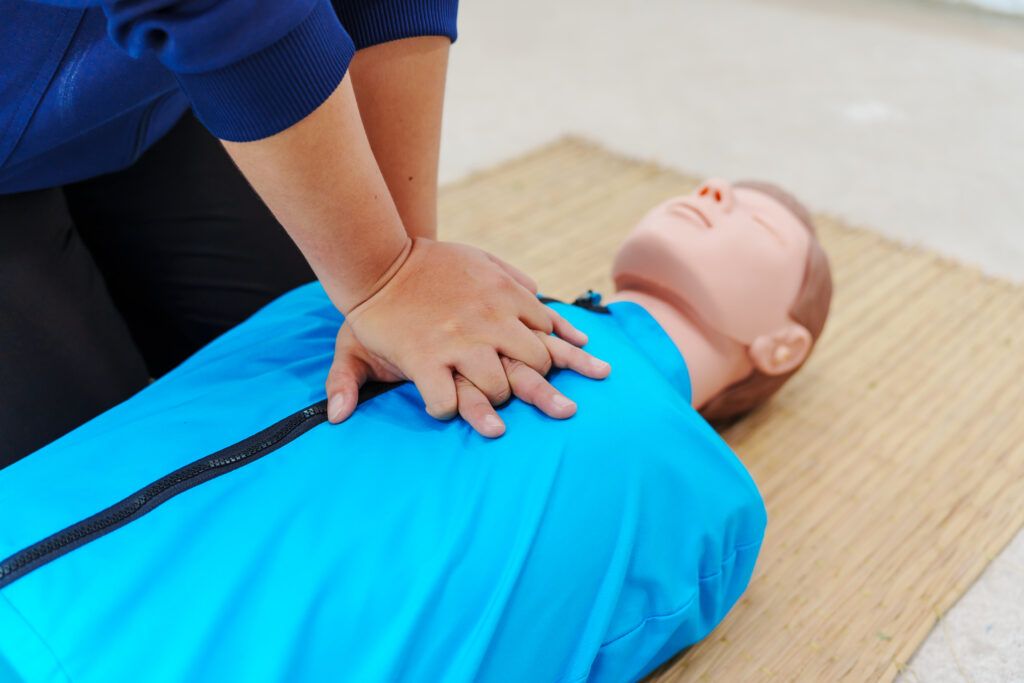
You can do CPR with no medical qualifications and no equipment. When a person’s heart stops beating or blood stops moving through their body, bystanders can double or triple that person’s chance of survival. CPR stands for cardiopulmonary resuscitation and describes the cycle of chest compressions and rescue breaths used to keep blood moving until paramedics take over. The steps of CPR can be learned in minutes.
When to Start CPR and How to Tell When Someone Needs Cardiopulmonary Resuscitation
Start CPR immediately when a person is not breathing normally and you cannot get a reaction from them. Cardiac arrest, drowning, choking, overdoses, and electric shocks can all leave a person unresponsive and not breathing, and the steps do not change with the cause.
When someone’s heart stops beating, blood flow to their brain ends within seconds and they collapse. A collapsed person can keep gasping, snorting, or moaning for a short while afterwards. Treat those gasps as no breathing at all. If you are in any doubt, do CPR anyway and let the paramedics make that judgement when they take over.
Checking for Danger and Response
Do CPR only where the scene is safe. Check for traffic, live electricity, fire, gas, and water before touching the person. If a hazard cannot be removed or avoided, stay back. A second casualty helps nobody and can delay help for the first.
If the area is clear, squeeze the person’s shoulders firmly and ask their name in a loud voice. A person who answers, groans, or pushes your hand away does not need CPR, but they may still need an ambulance for whatever caused their collapse. No reaction at all means they are unresponsive.
Calling Triple Zero and Sending for an Automated External Defibrillator

Call triple zero as soon as you know the person is unresponsive, and either put the phone on speaker or have someone else make the call. Stay on the line until help arrives. Anything you report is passed to the ambulance crew while they drive.
An automated external defibrillator or AED is a portable machine built to read a person’s heart rhythm and deliver a controlled shock when one is needed. If other bystanders are nearby, send someone to get the nearest one.
Clearing Their Airway and Checking Breathing
Open the person’s mouth and look for anything blocking the way, such as food, vomit, or loose teeth. Any rescue breaths you give when you do CPR can only pass through a clear airway. If you can see an object, roll them onto their side and sweep it out with your fingers. If their mouth is clear, leave them on their back.
Check the person’s breathing for no more than 10 seconds. Watch their chest, listen at their mouth, and feel for air on your cheek. If they are breathing normally but stay unresponsive, put them into the recovery position by rolling them onto their side with their top knee bent forward and their head tilted slightly back so that fluid can drain from their mouth. If they are not breathing normally, begin CPR.
Chest Compressions
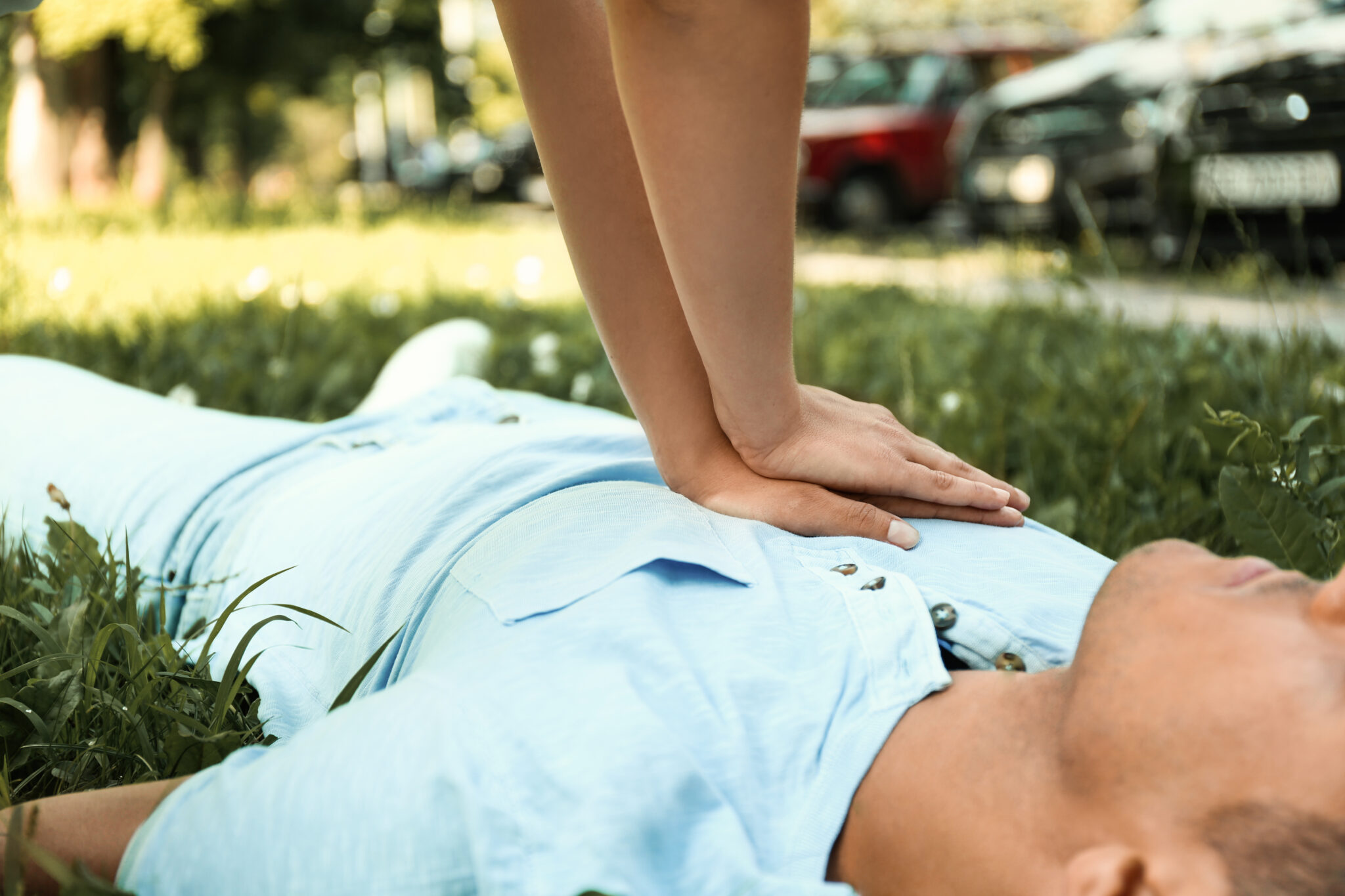
To perform the chest compressions needed to do CPR, kneel beside the person, place the heel of one hand on the lower half of their breastbone, and put your other hand on top with your fingers interlocked. Keep your arms straight and bring your shoulders directly above your hands.
Press hard and fast. Aim for 100 to 120 compressions per minute at about one third of the depth of the person’s chest, or 1 to 2 each second, for a total of 30 compressions. Let it rise fully between presses. For children and infants, use only the heel of one hand, while baby CPR needs only two fingers pressed into the centre of their chest.
Mouth-to-Mouth Resuscitation aka Rescue Breaths
After each set of 30 chest compressions, tilt the person’s head back gently with one hand on their forehead and lift their chin with your fingertips. Pinch their nose shut, seal your mouth over theirs, and blow steadily for about one second. Watch for their chest to rise as you blow. If it stays flat, tilt their head back a little further and fix the seal before the second breath. Give them two breaths in total and go straight back to compressions.
For a baby, keep their head level instead of tilted, seal your mouth over their mouth and nose together, and give small puffs rather than full breaths. The air held in your cheeks is enough to fill their lungs.
Using an AED
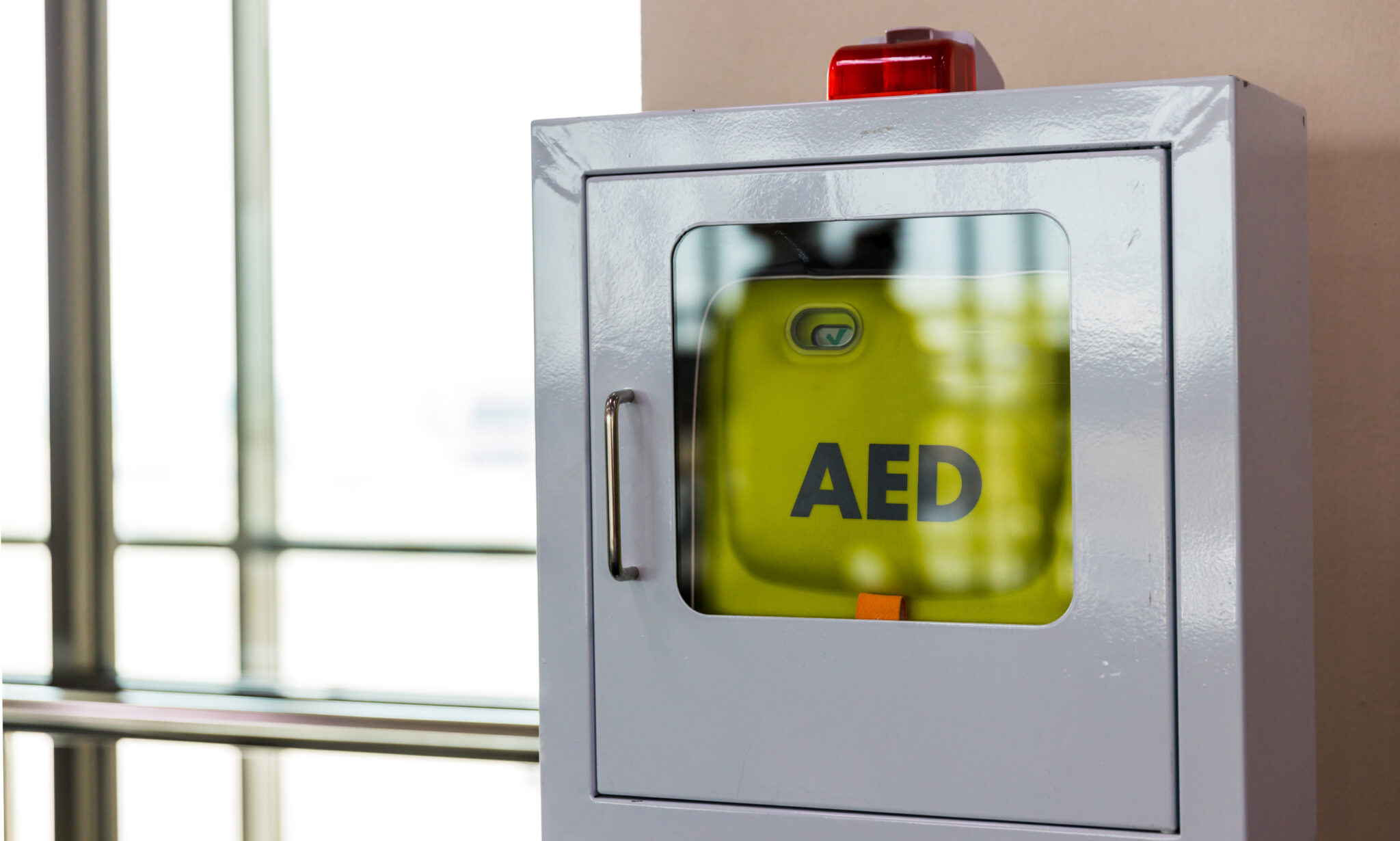
The moment an AED arrives, press its power button and follow the spoken directions. Every step is spoken aloud and repeated until it is done. These machines are built so that even untrained people can use them.
Bare the person’s chest and press the pads onto their skin in the positions drawn on each pad, with one below their right collarbone and one on their left side below their armpit. The AED reads their heart rhythm automatically. If a shock is advised, check that nobody is touching them and press the flashing button when told.
An AED should not be used on a child under one year old without paediatric pads, but using them takes professional-level training. Keep up the compressions and puffs until paramedics arrive with both.
Survival drops by about 10 percent for every minute that passes without compressions or a shock. Go back and do CPR between shocks when the AED prompts you to and leave the pads attached until paramedics take over.
When to Stop CPR
How long you press is decided by events rather than by the clock. Stop CPR only when:
- paramedics take over from you
- the person moves, opens their eyes, or starts breathing normally
- you are too exhausted to keep pressing to full depth
- the scene becomes dangerous and cannot be made safe
If the person revives, roll them into the recovery position.
If you become tired, trade places with another bystander every couple of minutes when a second pair of hands is available. Tired arms press shallower without their owner noticing. Fresh arms can do CPR at full depth. Time the swap for the breaths or for an AED rhythm check. No presses are lost that way. If you catch yourself pausing to see whether it is working, push on and leave that judgement to machines and paramedics.
Learn CPR by Enrolling in Perform CPR Training
Nobody gets time to look up how to do CPR in an emergency. With a CPR course, you can press, breathe, and shock without hesitating over depth, pace, or sequence. You can leave with a nationally recognised CPR certification and the skill to save a life before any ambulance arrives.
CPR skills can be the difference between life and death for the next person whose heart stops in front of you. The training takes only a few hours. Enrol in CPR training and be the bystander who already knows what to do.
FAQs
Can You Do CPR on Someone With a Pacemaker?
Yes. Presses are given in the same place regardless of any device under the person’s skin. If an AED is used, position the pad a hand-width clear of the hard lump so the shock is not blocked.
How Often Does a CPR Certification Need Renewing in Australia?
The national code of practice for workplace first aid recommends a CPR refresher every 12 months and a full requalification every three years. No separate law sets an expiry outside the workplace, which leaves that yearly rhythm as the one to follow.
Should You Do CPR on a Pregnant Woman?
Yes. Compressions, breaths, and defibrillation are given the same way during pregnancy. Acting quickly protects two lives instead of one.


