Sports first aid is the care a player receives in the minutes between an injury happening and a paramedic or doctor taking over. On a suburban oval or at a school athletics carnival, nobody in that window of time has a treatment room or a hospital trolley. The person standing closest to the injured player is usually a coach, a parent, or a teammate, and what that person does with the next few minutes shapes how the rest of the day goes.
Most sideline injuries are not emergencies, but a sportsperson who walks off under their own power can still have a fractured wrist or a brain injury that only declares itself an hour later. Sports first aid works because it treats what you can see while staying alert to what you cannot.
Common Sports Injuries
Injuries in Australian community sport tend to happen one of two ways. Something strikes the player, or the player’s body forces a joint or a muscle past what it can take. A direct impact from a shoulder, a cricket ball, or hard ground can leave bruising, cuts, fractures, and head injuries, while a hard twist or a sudden change of direction can tear the tissue that connects the skeleton together.
Soft tissue damage is a constant complaint at sporting clubs. More than half of all sports injury hospitalisations are fractures, most commonly to an arm or shoulder, and falls are the leading cause. Open wounds and grazes round out a typical season. An abrasion, meaning a graze where the top layers of skin have been scraped off, looks alarming on synthetic turf but rarely threatens beyond infection. Head knocks and heat illness can worsen well after the player leaves the field, and sports first aid has to account for that delay.
Assessing the Player First
Reaching straight for the ice pack is the most common mistake on any sideline. Before you treat the injury, check the player as a whole. A twisted knee matters very little if the person attached to it has stopped breathing. Australian first aid follows a sequence for this, known as DRSABCD:
- Danger. Scan the area for hazards before you go anywhere near the injured person. You cannot help someone if you become injured yourself.
- Response. Speak to the player and squeeze their shoulders to see whether they are conscious
- Send for help. Call Triple Zero on 000 or send someone else to do so for you.
- Airway. Open their mouth and clear anything blocking it.
- Breathing. Look, listen, and feel for normal breathing.
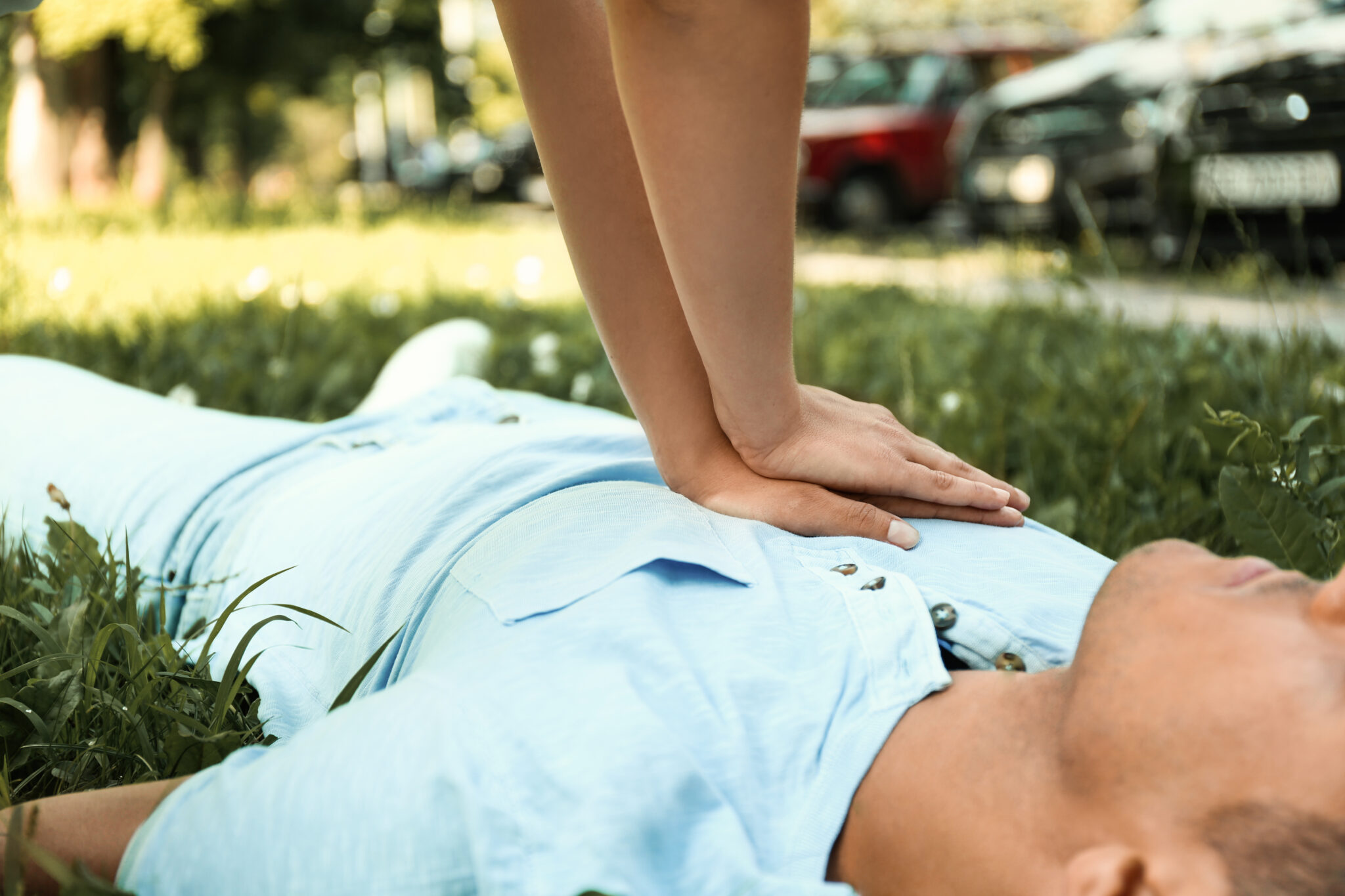
- CPR. Begin chest compressions and rescue breaths if the player is unresponsive and not breathing normally.
- Defibrillation. Attach an AED (automated external defibrillator) as soon as you can and follow the spoken prompts.
CPR stands for cardiopulmonary resuscitation, and the Australian standard is 30 compressions followed by 2 breaths, repeated until the player responds, paramedics take over, or you become too exhausted to physically continue.
Sprains and Strains

A sprained ankle turns up constantly in court sports, and hamstring and calf strains dominate anything involving sprinting. Both are managed the same way on the day, with the damaged tissue protected for a short window and then eased back into movement. Sports first aid for sprains and strains works best when the player goes home with an instruction to start moving gently within a few days rather than to stay off it until the pain disappears. The first few days follow the acronym PEACE:
- Protect. Restrict any painful movement or bearing weight on the injury for one to three days, before gradually resuming normal movement.
- Elevate. Raise the injured limb above the level of the heart if the player can do so comfortably.
- Avoid anti-inflammatories. Ibuprofen and similar medications suppress the inflammation the body uses to repair itself. The same caution applies to ice.
- Compress. Wrap an elastic bandage firmly around the joint or muscle, starting below the injury and working upwards.
- Educate. Ensure the player speaks to a doctor for advice on their specific injury.
Check the bandage every twenty minutes while the player waits. Ask the player to move the joint gently through whatever range does not hurt, and stop them at the point where it does.
Cuts, Grazes, and Bleeding Injuries

Bleeding looks worse than it usually is, and the fix is nearly always pressure. Put on disposable gloves, press a sterile dressing firmly onto the wound, and keep pressing for at least ten minutes without lifting it. If blood soaks through the dressing, add a second dressing on top of the first rather than removing it.
Wash an abrasion with clean water or saline to flush out grit before covering it. A non-stick dressing held with a bandage protects the raw skin, and dirt left in a graze causes both infection and permanent darkening of the skin. Deep cuts, wounds that gape open, and anything with an object embedded in it need a doctor rather than a sideline dressing.
Broken Bones, Fractures, and Dislocations

A fracture is the medical term for a broken bone, and a dislocation is a bone pushed out of its joint. You will not always be able to tell which one you are looking at, but you do not need to because the treatment is the same. Support the limb in the position you found it, keep the player still, and call an ambulance.
Do not attempt to straighten a deformed limb or push a dislocated shoulder back into place. A splint is any rigid support tied alongside the injury to hold the bone still while the player waits. Pad around the injury before you tie anything, and check that the person’s fingers or toes stay warm and pink after you secure it.
A bone that has broken through the skin, since that carries a high infection risk and needs a sterile dressing placed lightly over it without pressure. Sports first aid for suspected fractures is about preventing further damage, not about diagnosing what has broken.
Head Knocks and Signs of a Concussion

A concussion is a brain injury caused by a blow to the head or by a force transmitted through the body that jolts the brain inside the skull. A player does not have to lose consciousness to be concussed. Symptoms sometimes take minutes or hours to appear. Remove the player from the field immediately if you notice:
- Headaches, dizziness, or blurred vision
- Memory loss about the incident
- Nausea, vomiting, or unsteadiness
- Confusion, a blank stare, or slowed responses to questions
- Irritability, unusual emotion, or drowsiness
The player must not return to play on the same day under any circumstance. The Australian concussion guidelines require a minimum of 21 days from the incident before a return to competitive contact sport, with at least 14 of those days completely symptom free, and a healthcare practitioner has to clear the player first.
Call an ambulance straight away if the player loses consciousness, has a seizure, vomits repeatedly, complains of neck pain, or becomes increasingly confused. Sports first aid for head knocks is simple in principle, because your only decision is whether to remove the player, and the answer whenever you are unsure is yes.
Heat Exhaustion and Heat Stroke

Australian summers put every sport at risk, and heat illness develops in stages. Heat exhaustion presents as heavy sweating, dizziness, nausea, cramping, headaches, and pale clammy skin, and the player stays conscious and coherent. Move them into shade, remove excess clothing and padding, give cool water in small sips, and cool their skin with wet towels or a fine mist.
Heat stroke is the medical emergency at the far end of the spectrum. The player becomes confused, aggressive, or uncoordinated, may stop sweating, and can collapse or seize. Once core body temperature passes 40 degrees Celsius the risk of heat stroke rises sharply, and their organs begin to sustain damage within minutes. Cooling them down cannot wait for the ambulance.
Cool the player aggressively while you wait. Immersion in cold water is the fastest method where a tub or a pool is available, and where it is not, an ice pack or cold packs against their neck, armpits, and groin while you keep the skin wet and fan air across it. Any collapse in hot conditions should be treated as heat stroke until proven otherwise. Sports first aid in heat rewards preparation, so shaded areas, drink breaks, and rescheduled start times prevent far more cases than treatment ever resolves.
Deciding Whether a Player Returns to the Game

Sports coaches face this decision with every injury. A player is not a reliable judge of their own condition. A trainer’s job is to apply a rule you decided on before the game started, not to negotiate one during it.
Any suspected concussion, any suspected fracture or dislocation, any loss of consciousness, and any sign of heat illness beyond mild cramping mean the player is finished for the day. Pain that stops a player from bearing weight, jogging in a straight line, any uncontrollable bleeding. or moving a joint through its normal range also ends their game time. Sports first aid puts that decision in your hands, so make it early and say it once rather than leaving it open for the rest of the game.
Stocking a Sideline First Aid Kit

A sports first aid kit is only useful if it is portable, restocked, and within twenty metres of the play area. Buy a soft case with compartments rather because you will be carrying it onto the ground at speed. Check it after every game as its contents are likely to get used quickly. A workable portable kit for a community club should hold:
- Disposable gloves
- Sterile gauze
- Both stick and non-stick dressings and pads
- An elastic compression bandage
- Triangular bandages for slings
- A splint
- Instant cold packs
- Sports strapping tape
- Scissors
- Saline sachets
- A thermal blanket
Enrol in First Aid Training
First aid techniques are learned by doing them. Our HLTAID011 Provide First Aid course teaches the skills and knowledge behind sideline care, from DRSABCD and bleeding control to fracture management and heat illness. It includes HLTAID009 Provide Cardiopulmonary Resuscitation as part of it. The people with the clearest benefit from this training are the ones already standing on the sideline every weekend. Enrol in a first aid course with us and you will handle the next incident on your ground with a plan instead of an instinct.
FAQs
Does a Community Sporting Club Need a Qualified First Aider?
Sports first aid requirements vary by state, by sport, and by whether the club employs anyone, so check with your state sporting body and your insurer. Many national codes require an accredited sports trainer or first aider at sanctioned fixtures, and clubs with paid staff also fall under work health and safety duties. Having at least two trained people at every fixture is sensible regardless of the minimum requirement.
Can I Complete First Aid Training Online?
No. Basic first aid training requires you to demonstrate CPR on a mannikin, which can only be done in-person under your trainer’s direct supervision.
What Should I Do With a Knocked Out Tooth?
Pick the tooth up by the crown rather than the root, and do not scrub it clean or wrap it in a tissue. Put it straight back into their socket if the player will let you, otherwise store it in milk or ask them to keep it inside their cheek.